




Radka Částková and Magdalena Šimurdová
What we carry on our shoulders is hidden in our innermost being.
All the thoughts, the wishes, the unspoken sentences, the light and serious conversations we have had. Many times, as children, we have tried to create an echo in different places. In hindsight, we find that shouting into the wind is kind of silly — and in adulthood, we tend to smile at the idea. Repeated endings of short messages that should rather be at the end. But in essence, it brings us back to the beginning — to ourselves, to what we have said and what we are saying, who we are and where we intend to go.
The echo keeps us in the present and resonates within us like all sorts of news, information, and situations that wash away, colour, and modify until they almost disappear. The echo is carried across the landscape; over time, it washes away the informational value that cycles through, like life itself.
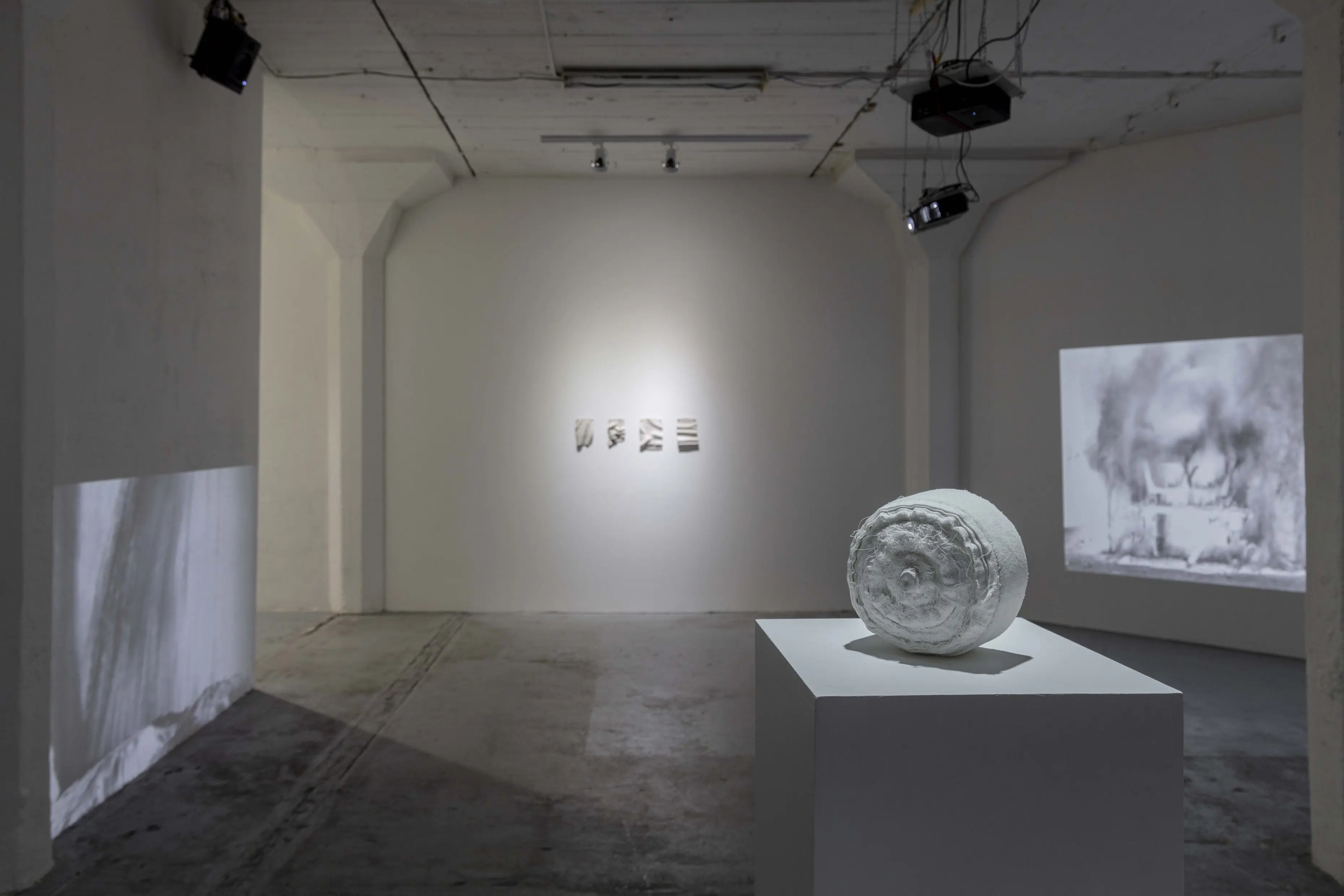
Similarly, in his work, Łukasz Horbów takes on the “natural” social order and natural phenomena, metaphorically pointing to the existential necessity of our life — being.
What lives we live, where we are heading, and what events are happening around us — even though they may leave us with a sense of unease or a spike of fear — resonate within us constantly, like that cycling echo. The author points to the helplessness or blind faith of humanity in the change that nature can bring about in a single moment, from which something new and better can be born.
At least that is always carried by the echo.
How do you personally perceive the term “cycle”?
ŁH: For me, a cycle is life. We are born, we die, and so on and so forth. In the sculptures presented in the exhibition, I use mainly natural materials — unfired clay or jute string — so that their cycle does not end.
If they cease to exist in the context of art, they can simply return to it without harming it.
In both videos, I use found footage so that they also become part of a “cycle” of recycled images produced by society.
Is the present or the past more of a supporting element for your work?
ŁH: The past and the future are the same thing to me. With my work, I want to capture something outside of time — beyond the past, present and future — so everything has the potential to last forever, to exist only in the present or to be lost in history.
We must penetrate the depths and immerse ourselves. To gain confidence, we must explore every corner — whether we’re digging through the material from which we build our imaginations, creating magical spaces layer by layer, or trying to capture fleeting moments.
ENTRY – Pragovka Gallery
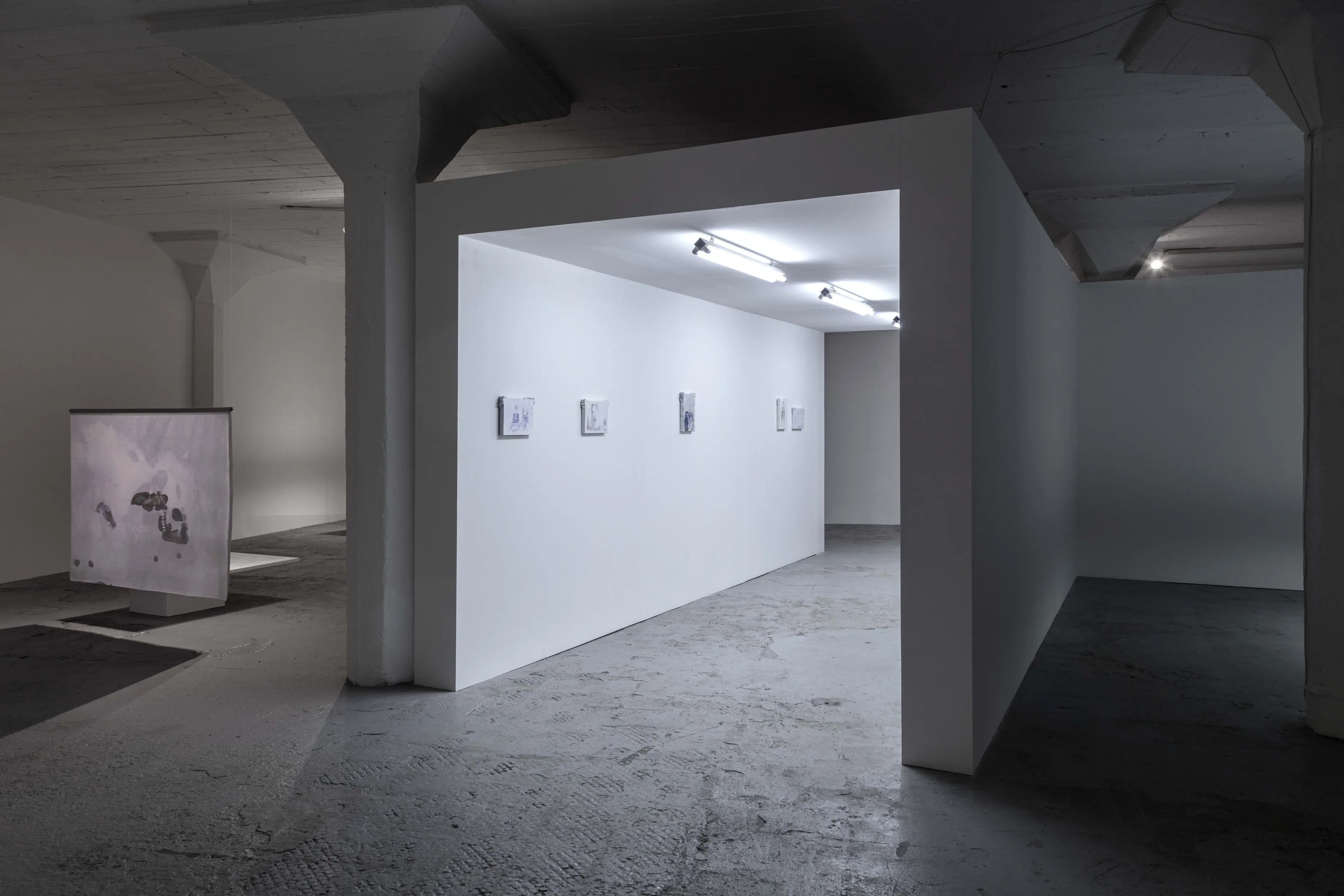
The ENTRY section of Pragovka Gallery hosts works by four artists connected by the lyrical aspect of their art.
Through this sensibility, they formulate with ease otherwise difficult-to-grasp themes relating to our presence — space — landscape.
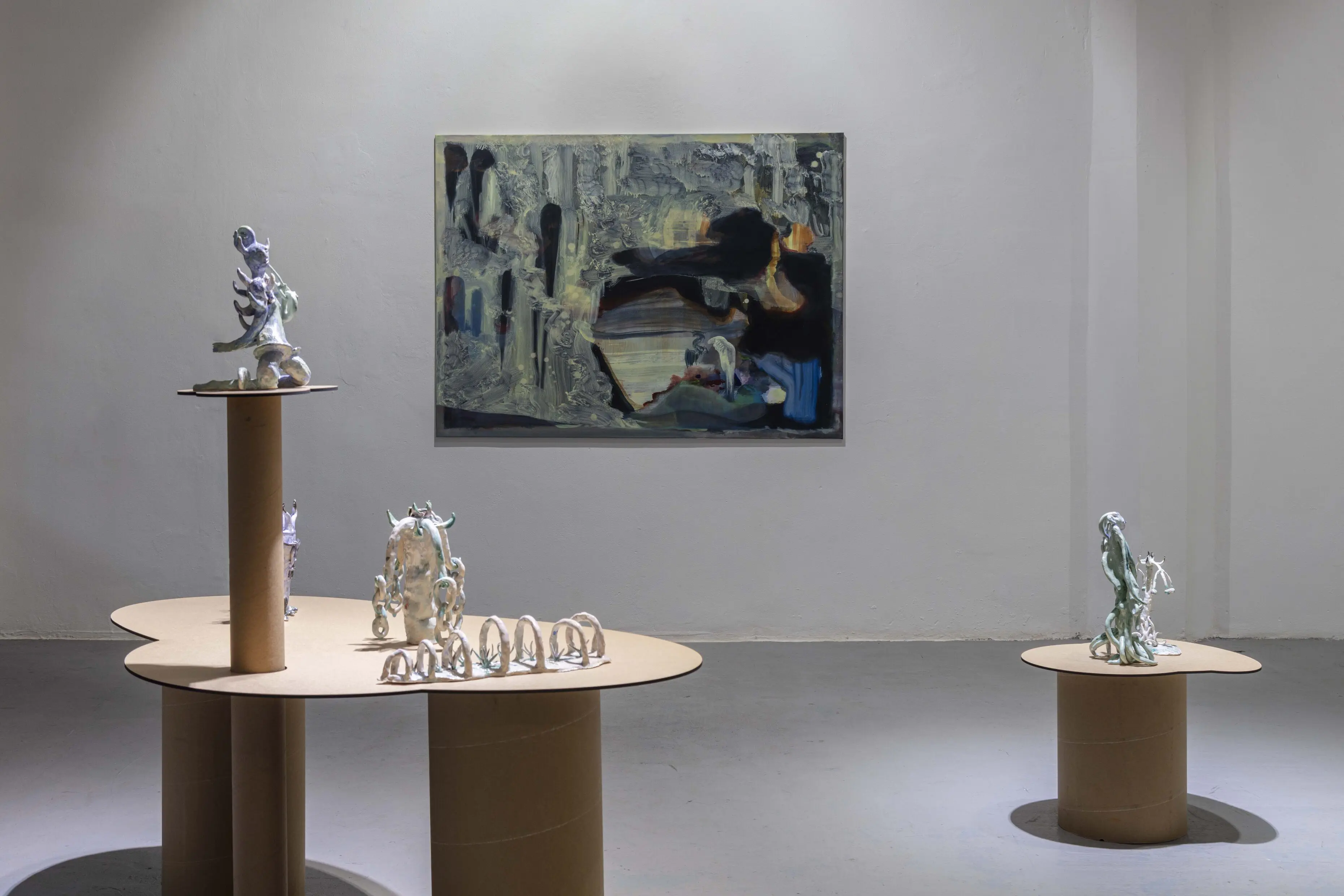
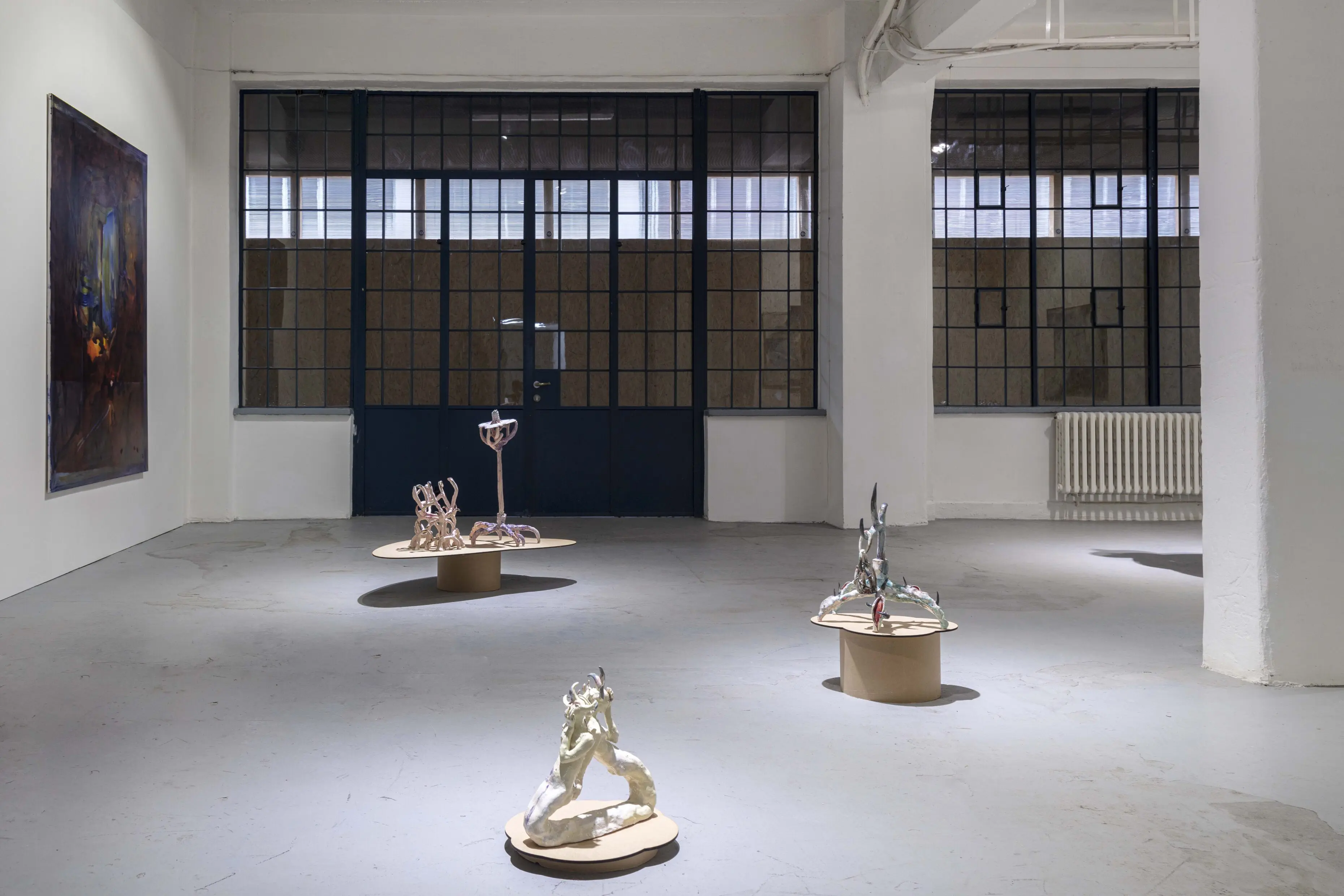
Anna Bochková’s ceramic objects often depict the power and magic of nature, engulfing and transforming everything humanity has created — like an imaginary battle between good and evil.
Fragments of memories, narratives and stories are preserved in mythical figures, architectural objects and subtle symbols that invite closer observation.
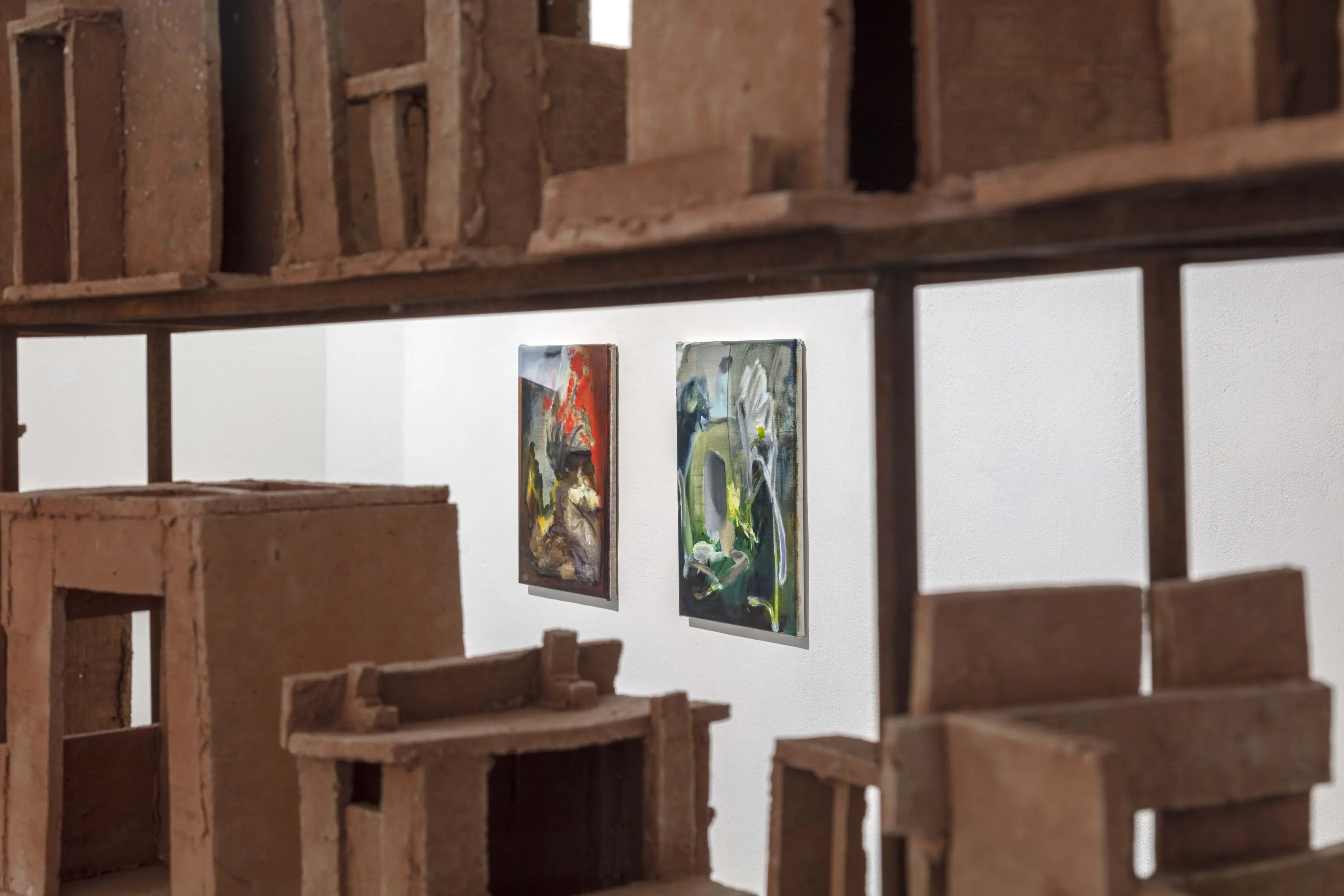
Robert Buček’s monumental installation Where We Will Not Live is not merely an exaggeration but a key motif to which the author continually returns. A certain uncertainty, reflected in the abandoned torsos of terracotta buildings, is eerily tied to our present.
This motif’s relevance leads Robert to create new layers of meaning — as in the sculpture Hideout for Uherské Hradiště — and shapes his unmistakable artistic language.
Julie Hrnčířová’s artefacts blend everyday situations, chance encounters and poetic corners, presented in various material combinations. She highlights otherwise neglected moments that frame our present. In this case, ceramic frames elevate photography into the realm of independent objecthood.
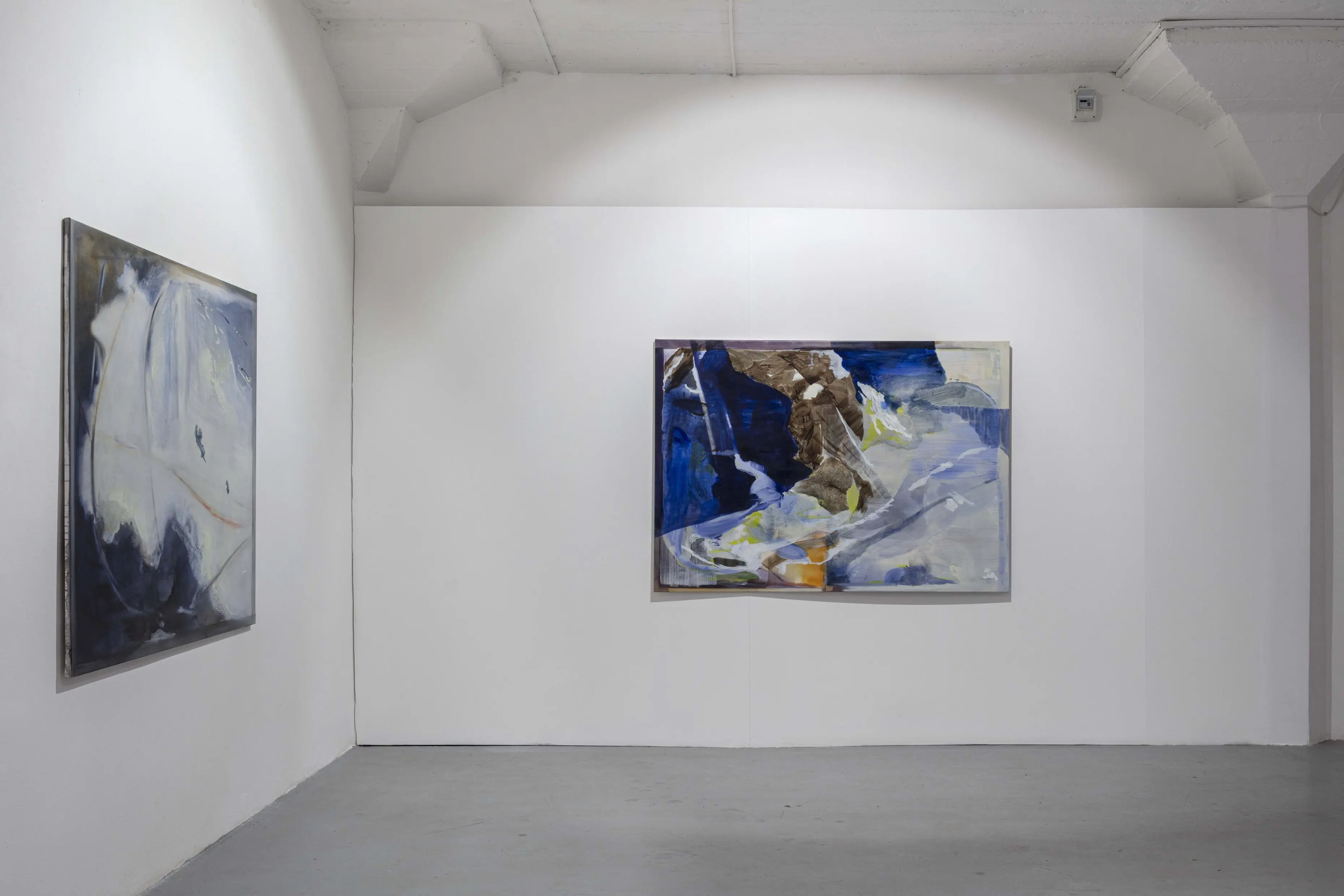
Jan Valik’s visual traces, gestures and strong imagery reveal an almost investigative interest, merging in large-format abstract paintings that emerge from the artist’s inner world.
How do you work with memories in your art?
AB: Memories are a very strong driving force for my work. My childhood memories, fairy tales and spoken stories, as well as traumas and uncertain experiences, often become the stories of my practice. It is important for me to keep that complex but playful background and make the work accessible to others.
JV: Memories are an interesting and somewhat elusive phenomenon. They are fluid — each time they are created anew or reappear in consciousness. Over time, memories, imagination and a kind of waking dream intertwine, changing perspective and perception of time.
This movement between the experienced and the imagined happens almost unnoticed. It becomes an archetype of transformation — from subjective and collective memory into the image itself, at the edge between the inner and the outer. It’s an active territory that I explore through painting.
RB: Memory is one of the key points in my work. Most of the sculptures I make are illustrations of memories — or rather, what is left of them in my imagination. The story, feeling or place always leaves a visual trace that I work with. Usually, it’s a simplified version, a detail, or a distorted reality — but that makes it even truer.
JH: I’m most interested in the memories of the city — and especially in the memories of the objects within it. I “collect” discarded items from public spaces — things that have been thrown away, repaired, or altered. In the photographs and ceramic frames presented in the exhibition, I return to my childhood, when I often worked with clay. It calms me, and I enjoy creating naive and imperfect forms. These frames also relate to found still lifes I collect in urban spaces.
Can you immerse yourself in your work?
AB: Of course. My work is my main anti-stress mechanism — it’s a lifestyle. There’s literally no time when I’m not thinking about a project, producing, or preparing it.
My formal and conceptual work is deeply connected to my beliefs about society, equality, solidarity and ethics. Sometimes I speak about these themes directly; other times, I construct systems of objects that express them metaphorically.
JV: Immersion through painting is perhaps the most essential moment in my process. I try to create studio conditions that allow this immersion to happen — a state where painting goes beyond the original plan and intuition seeps through the filters of logic and mind. That’s the ideal moment when the painting happens and the image emerges.
RB: Concentration and immersion are ideal states — but that doesn’t necessarily mean they lead to satisfying results. Sometimes, it’s quite the opposite.
JH: Yes — but sometimes I lack the time to stay with my work longer.
Are you more of a dreamer, or do you prefer to keep your feet on the ground?
AB: I’m definitely a dreamer; otherwise, I’d be doing something other than art. But I think we need both — the ability to dream and a pragmatic approach. My projects always start with a dream, then a plan to make it happen.
JV: Part of me aligns with the dreamer, another part with grounding. It’s a cycle — one defining the other. These two needs alternate, and it’s not always easy to tell them apart. I often drift off into imagination, so I consciously try to ground my thinking. Finding balance between these polarities is not easy — especially in art, culture and creation.
RB: I dream of one day standing with my feet on the ground.
JH: It depends.
FOYER – Pragovka Gallery
Visitors enter and exit through the FOYER of Pragovka Gallery.
It’s like a detective novel — at the beginning of the first chapter you meet the main characters (the artists), and your task before leaving is to uncover the central motif of the exhibition.
Many argue that art speaks for itself and doesn’t need excessive explanation or hidden pattern-seeking. Yet we often find ourselves wishing for a helping hand.
Just as a detective story takes time to unravel, so does art. It forces us to think, perceive, and occasionally comment — which is not easy.
Especially when we’re in a space that serves as a home for artworks — a place vastly different from our own idea of home.
As O’Doherty writes in Inside the White Cube:
“Indeed, the presence of that odd piece of furniture — your own body — seems superfluous, an intrusion.”
That’s why, in the third act, we find artists who actively explore this space — analysing its transformations, creating diagrams, and inviting viewers to participate.
Draw Me a House
The installation Draw Me a House by Jonas Vansteenkiste and Thomas Jacques takes us into a familiar environment — our home. Even childhood drawings reveal how important the symbol of the house is and how our imagination reshapes that space.
How has your perception of home changed with age, experience, and your current situation?
The task is simple: draw a house.
Over time, the growing installation becomes an archive rich in interpretation.
In Anna König Vlk’s art experiment @art.mindpattern, we move from our homes into the gallery — a space that defines the overall perception of exhibitions and turns us towards the most crucial point: the possibility of understanding and interpreting artworks.
What if the minds of the curator, artist, and viewer differ so greatly that understanding never occurs?
How do we perceive the gallery and its laws? Are there hidden patterns of thought that could lead us to shared consciousness?
This Act: The Space That Surrounds Us
TJ: As a writer, I like to observe the space around me and then reshape it in my mind. I see stories everywhere.
AKV: Space is a dominant element for me — in both my personal and professional life. I first need to connect with it, to find its rules and its charm, which then give me the freedom to shape it. I would compare this process to an installation. In that sense, I am more of an observer.
JV: I think I do both — starting as an observer, collector, and writer in my sketchbooks. I love situations, facts and emotions. I can spend hours observing a place or thinking about concepts like scripted space, theme parks, or immersive experiences.
As a visual artist, I also shape these elements. It’s not always about reshaping — in my installations, I often use familiar architectural forms to guide the viewer’s experience, reflection, or emotion.
“Viewer” isn’t quite right — in my ideal vision, they are participants, activated by the work, who feel and even complete it.
Thomas and Jonas, what does “home” mean to you?
TJ: For me, home is a safe space. A place where I can rest — where I can truly be myself.
JV: For me, there are two starting points — the personal layer and the artistic one. The artist’s layer is more in control.
As a person, I have a dual relationship with the concept of home — both safe and uncomfortable at once. This ambivalence, rooted in my personal history, nourishes me as an artist.
The house is a universal yet deeply personal motif — an ideal field for engaging viewers through shared experience.
As Donald Winnicott said:
“Home is where we start from. It is the foundation of our being. It shapes how we approach the world.”
And where do you feel at home?
TJ: First and foremost, in my house surrounded by nature. Our home is like a small museum — telling the story of my life, my wife’s, and our family’s. It’s full of books, art, and historical objects that we love to collect.
I feel at home where there are lots of books — and in nature, especially among snowy mountains.
JV: That’s a tricky question. I move fluidly within the feeling of home. While home functions as a kind of base, I can easily feel at home in unfamiliar contexts too.
I love hotel rooms, airports, train stations, and the in-between spaces. I feel strangely at home there — perhaps because of the anonymity, and the freedom from social roles we usually inhabit at home.
Don’t get me wrong — I love the home my partner and I have built.
But I think I need the interplay between being at home, being on the road, and returning home — to grow and to be myself.